
History-
The origin of the word "clown" is uncertain. It first appears around the 1560s and may come from a Scandinavian linguistic root meaning "clumsy, boorish fellow" (Icelandic klunni and Swedish kluns). A similar term also exists in North Frisian — klönne, meaning "clumsy person". The meaning of clown as a fool or jester is c. 1600. "Clown" as a verb appears much later — the early 20th century — and may be linked to music hall.
The most ancient clowns have been found in the Fifth dynasty of Egypt, around 2400 B. Unlike court jesters, clowns have traditionally served a socio-religious and psychological role, and traditionally the roles of priest and clown have been held by the same persons.
Peter Berger writes that "It seems plausible that folly and fools, like religion and magic, meet some deeply rooted needs in human society". For this reason, clowning is often considered an important part of training as a physical performance discipline, partly because tricky subject matter can be dealt with, but also because it requires a high level of risk and play in the performe
.gif?timestamp=1486833846011)
White Face-
The "whiteface" makeup was originally designed by Joseph Grimaldi in 1801. He began by painting a white base over his face, neck and chest before adding red triangles on the cheeks, thick eyebrows and large red lips set in a mischievous grin. Grimaldi's design is used by many modern clowns. According to Grimaldi's biographer Andrew McConnell Stott, it was one of the most important theatrical designs of the 1800s. The whiteface clown, or clown blanc from the original French, is a sophisticated character, as opposed to the clumsy auguste. They are also distinguished as the "sad clown" (blanc) and "happy clown" (auguste).
Classic appearance. Traditionally, the whiteface clown uses "clown white" makeup to cover his or her entire face and neck with none of the underlying flesh color showing. In the European whiteface makeup, the ears are painted red. Features, in red and black, are delicate. He or she is traditionally costumed far more extravagantly than the other two clown types, sometimes wearing the ruffled collar and pointed hat which typify the stereotypical "clown suit".
America's first great white faced clown was stage star George "G.L." Fox. Following English Joseph Grimaldi, Fox popularised the Humpty Dumpty stories throughout the land in the first half of the 19th century in America.
Appearance-
The auguste face base makeup color is a variation of pink, red, or tan rather than white. Features are exaggerated in size and are typically red and black in color. The mouth is thickly outlined with white (called the muzzle) as are the eyes. The auguste is dressed (appropriate to character) in either well-fitted garb or in a costume that does not fit – either oversize or too small is appropriate. Bold colors, large prints or patterns, and suspenders often characterize auguste costumes.
The auguste character-type is often an anarchist, a joker, or a fool. He is clever and has much lower status than the whiteface. Classically the whiteface character instructs the auguste character to perform his bidding. The auguste has a hard time performing the given task which leads to funny situations. Sometimes the auguste plays the role of an anarchist and purposefully has trouble following the whiteface's directions. Sometimes the auguste is confused or is foolish and is screwing up less deliberately.
The contra-auguste plays the role of the mediator between the whiteface character and the auguste character. He has a lower status than the whiteface but a higher status than the auguste. He aspires to be more like the whiteface and often mimics everything the whiteface does to try to gain approval. If there is a contra-auguste character, he often is instructed by the whiteface to correct the auguste when he is doing something wrong.
The character clown adopts an eccentric character of some type, such as a butcher, a baker, a policeman, a housewife or hobo. Prime examples of this type of clown are the circus tramps Otto Griebling and Emmett Kelly. Red Skelton, Harold Lloyd, Buster Keaton, and Charlie Chaplin would all fit the definition of a character clown.
The character clown makeup is a comic slant on the standard human face. Their makeup starts with a flesh tone base and may make use of anything from glasses, mustaches and beards to freckles, warts, big ears or strange haircuts.
North American-
The most prevalent character clown in the American circus is the hobo, tramp or bum clown. There are subtle differences in the American character clown types. The primary differences among these clown types is attitude. According to American circus expert Hovey Burgess, they are (in order of class):
The Hobo: Migratory and finds work where he travels. Down on his luck but maintains a positive attitude.
The Tramp: Migratory and does not work where he travels. Down on his luck and depressed about his situation.
The Bum: Non-migratory and non-working.
Emmett Kelly was the preeminent clown of this type. Others include Barry Lubin, Tom Dougherty,Bill Irwin, David Shiner, Geoff Hoyle, Funny Man Poodles, John Gilkey, Eric Davis, Peter Shub, Poodles Hanneford, Bluch Landolf, Larry Pisoni, John Lepiarz, Bobo Barnett, Happy Kellams,Fumagalli, Charlie Cairoli, Bebe, Jojo Lewis, Abe Goldstein, Rhum, David Larible, Scott Linker, Kenny Raskin, Oleg Popov, Rik Gern, Bello Nock, Vance Colvig, Jr. and (among his other acts) Red Skelton.
Many native tribes have a history of clowning. The Canadian Clowning method developed by Richard Pochinko and furthered by his former apprentice, Sue Morrison, combines European and Native American clowning techniques.
In this tradition, masks are made of clay while the creator's eyes are closed. A mask is made for each direction of the medicine wheel. During this process, the clown creates a personal mythology which explores his or her personal experiences and innocences.
Commedia dell'Arte-
There are two distinct types of clown characters, which originated in Commedia dell'Arte but which still hold some favor today, Pierrot and Harlequin.
Pierrot or Pirouette - Derived from the commedia dell'arte character Pedrolino – the youngest actor of the troupe, deadpan and downtrodden. Although Pedrolino appeared without mask, Pierrot usually appears in whiteface, typically with very little other color on the face. Like Arlecchino, Pedrolino's character changed enormously with the rising popularity of pantomime in the late 19th century, becoming Pierrot. This clown character prefers black and white or otherwise a simple primary color in his or her costume. (le Pierrot is often female, and has also been called "Pirouette" or "Pierrette". When Bernard Delfont was made a life peer, he chose "Pierrot and Pierrette" as the heraldic supporters of his coat of arms.).
Both women have names which translate as "red", but Reuben's true love is dressed in pure white. The other, to whom he played his fateful song, is the "lady in red." This symbolism might imply that Reuben was Pierrot's companion, Arlecchino:
Harlequin, or Arlecchino, is a "motley" clown. In the Commedia, Arlecchino always carries a cane with which to strike the other performers, although this cane is normally taken from him by the other performers and used against him. This is believed to be the origin of the slapstick form of comedy. A slapstick (battacio in Italian), is a prop with two flat flexible wooden pieces mounted in parallel so that the two sticks slap together when the implement is struck, causing a slapping sound, exaggerating the effect of a comedic blow. Despite the slapstick, Arlecchino is not malicious, but mischievous, the slapstick being a classic example of carnivalesque phallic imagery (see also the commedia masks' noses).
Like a cross between the characters of Puck and Nick Bottom in A Midsummer Night's Dream, Arlecchino is nimble and adept at the same time as being clumsy and dim, and is normally the 'messenger' character in a comedy — the catalyst for mayhem.
Arlecchino has a female counterpart, Arlecchina, or Rosetta, but more often he is in love with the character of Columbina, a straightforward and intelligent maid, who is usually given the prologue and epilogue.
Arlecchino has other derivatives with slightly different features: Traccagnino, Bagattino, Tabarrino, Tortellino, Naccherino, Gradelino, Mezzettino, Polpettino, Nespolino, Bertoldino, Fagiuolino, Trappolino, Zaccagnino, Trivellino, Passerino, Bagolino, Temellino, Fagottino, Fritellino, Tabacchino, whose names could all be considered funny-sounding names, even to an Italian. Arlecchino's name is probably derived from "hellech" plus the diminutive suffix "-ino", meaning little devil. In the same way, "Trufflino" is "Little Truffler", Trivellino is (Arlecchino's) "Little Brother", and so on. The Harlequin often loses much of Arlecchino's character in pantomime, as he becomes more of a ballet character, to a large extent stripped of dialogue and subversive content.
Joseph Grimaldi was the most celebrated of English clowns, his performances made this character central in British harlequinades.
Clowns International-
Clowns International claims to be the oldest clown society in the world. It was set up in 1946. Apart from being a membership organisation Clowns International has set up a museum of clown memoribilia and a register of clown make-up. The latter has full eggshells which are decorated as replicas of the specific clown's head.
In the circus, a clown might perform another circus role:
Walk a tightrope, a highwire, a slack rope or a piece of rope on the ground.
Ride a horse, a zebra, a donkey, an elephant or even an ostrich.
Substitute himself in the role of "lion tamer".
Act as "emcee", from M.C. or Master of Ceremonies, the preferred term for a clown taking on the role of "Ringmaster".
"Sit in" with the orchestra, perhaps in a "pin spot" in the center ring, or from a seat in the audience.
Anything any other circus performer might do. It is not uncommon for an acrobat, a horse-back rider or a lion tamer to secretly stand in for the clown, the "switch" taking place in a brief moment offstage.
Frameworks-
Frameworks are the general outline of an act that clowns use to help them build out an act. Frameworks can be loose, including only a general beginning and ending to the act, leaving it up to the clown's creativity to fill in the rest, or at the other extreme a fully developed script that allows very little room for creativity.
Shows are the overall production that a clown is a part of, it may or may not include elements other than clowning, such as in a circus show. In a circus context, clown shows are typically made up of some combination of Entrées, Side dishes, Clown Stops, Track Gags, Gags and bits.
"Business" is the individual motions the clown uses, often used to express the clown's character. A "gag" is a very short piece of clown comedy which when repeated within a bit or routine may become a "running gag". Gags may be loosely defined as "the jokes clowns play on each other". Bits are the clown's sketches or routines made up of one or more gags either worked out and timed before going on stage or impromptu bits composed of familiar improvisational material. A gag may have a beginning, a middle and an end to them, or they may not. Gags can also refer to the prop stunts/tricks or the stunts that clowns use, such as a squirting flower.
Entrées are feature clowning acts lasting 5–10 minutes. They are typically made up of various gags and bits, and usually use a clowning framework. Entrées almost always end with a blow-off. (The blow-off is the comedic ending of a show segment, bit, gag, stunt or routine.)
Side dishes are shorter feature acts. Side dishes are essentially shorter versions of the Entrée, typically lasting 1–3 minutes. Side dishes are typically made up of various gags and bits, and usually use a clowning framework. Side dishes almost always end with a blow-off.
"Clown Stops" or "interludes" are the brief appearances of clowns while the props and rigging are changed. These are typically made up of a few gags or several bits. Clown Stops almost always end with a blow-off. Clown stops will always have a beginning, a middle and an end to them. These are also called reprises or run-ins by many and in today's circus they are an art form in themselves, originally they were bits of "business" usually parodying the act that had preceded it. If for instance there had been a wire walker the reprise would involve two chairs with a piece of rope between and the clown trying to imitate the artiste by trying to walk between them with the resulting falls and cascades bringing laughter from the audience. Today they are far more complex and in many modern shows the clowning is a thread that links the whole show togethe
Among the more well-known clown stunts are: squirting flower; the "too-many-clowns-coming-out-of-a-tiny-car" stunt; doing just about anything with a rubber chicken, tripping over ones own feet (or an air pocket or imaginary blemish in the floor), or riding any number of ridiculous vehicles or "clown bikes". Individual prop stunts are generally considered to be individual bits.

Fear of Clown-
The term coulrophobia has been proposed to denote an abnormal, exaggerated, or irrational fear of clowns. The term is of recent use but is not commonly used in psychology, and according to one analyst, "has been coined more on the Internet than in printed form because it does not appear in any previously published, psychiatric, unabridged, or abridged dictionary". In particular, the term is not recognised as a specific disorder by theAmerican Psychiatric Association in its latest categorisation of disorders, nor is it recognised by the World Health Organisation as a valid disorder.
In the Space To Care study aimed at improving hospital design for children, researchers from the University of Sheffield polled 250 children regarding their opinions on clowns; all 250 children in the study, whose ages ranged between four and sixteen, reported that they disliked clowns as part of hospital decor. Many of them, including some older children, stated in the poll that they, in fact, actively feared clowns.
Clown costumes tend to exaggerate the facial features and some body parts, such as hands and feet and noses. This can be read as monstrous or deformed as easily as it can be read as comical. Some have suggested, however, that a fear of clowns may stem from early childhood experience, when infants begin to process and make sense of facial features.The significant aberrations in a clown's face may alter a person's appearance so much that it enters the so-called "uncanny valley" (in which a lifelike figure is so lifelike to be disturbing but not realistic enough to be pleasant) and thus frightens a child so much that they carry this phobia throughout their adult life.
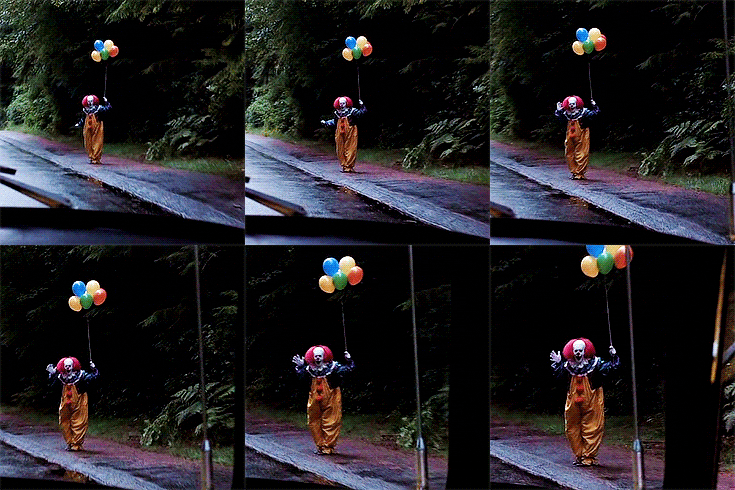
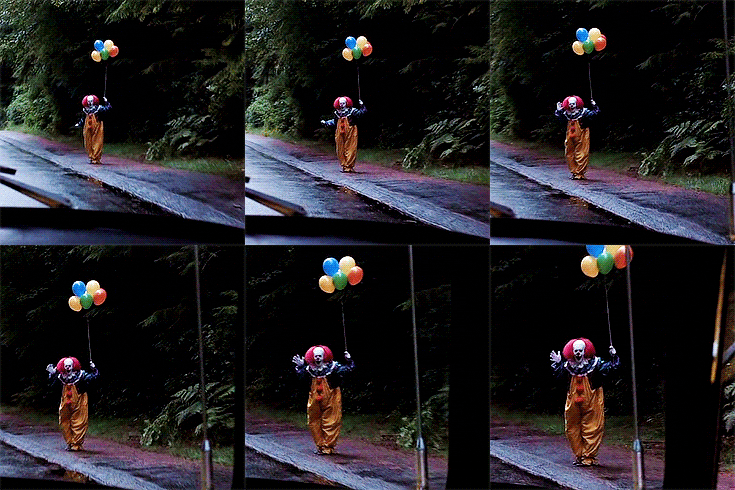
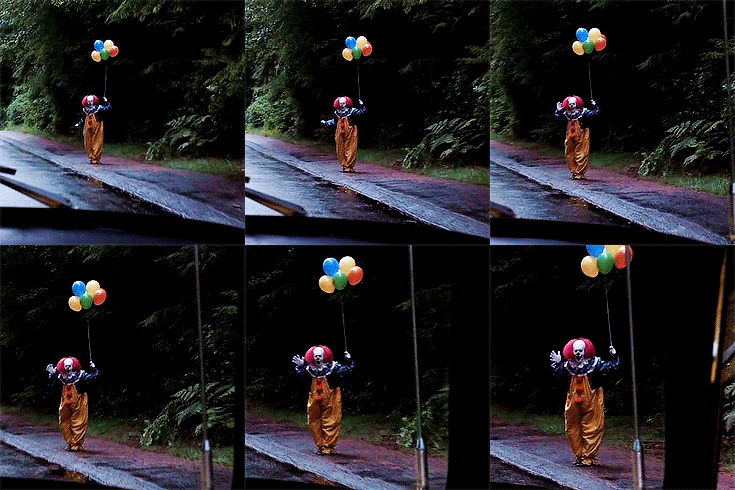
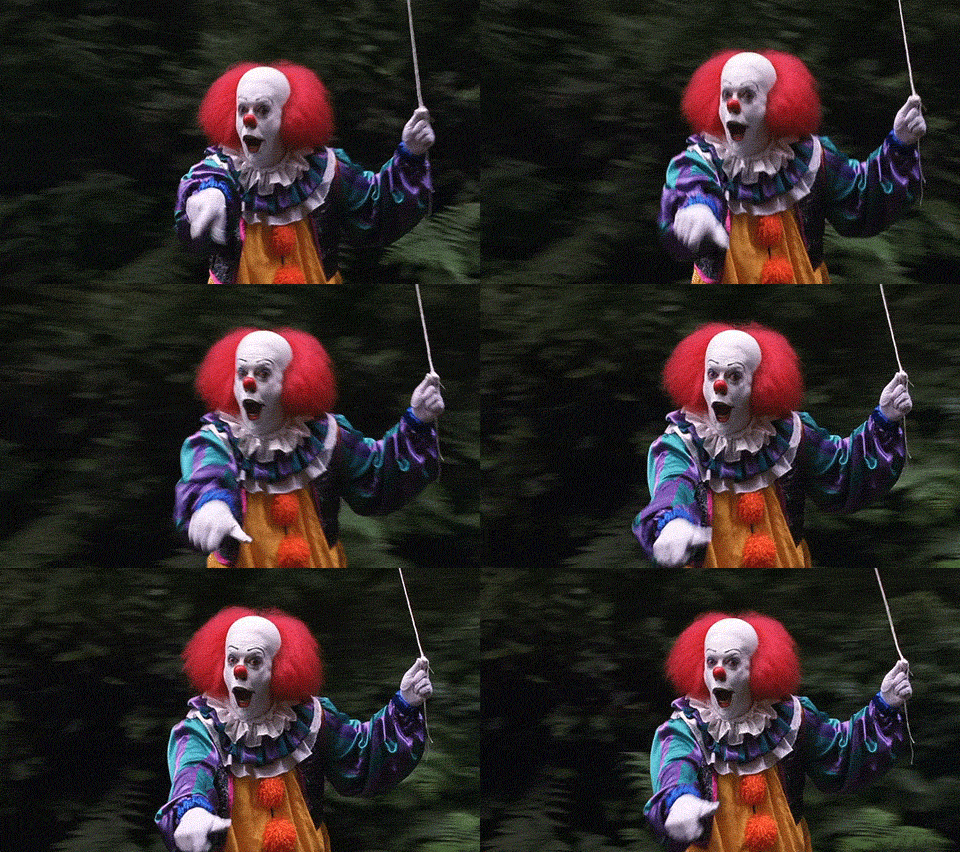
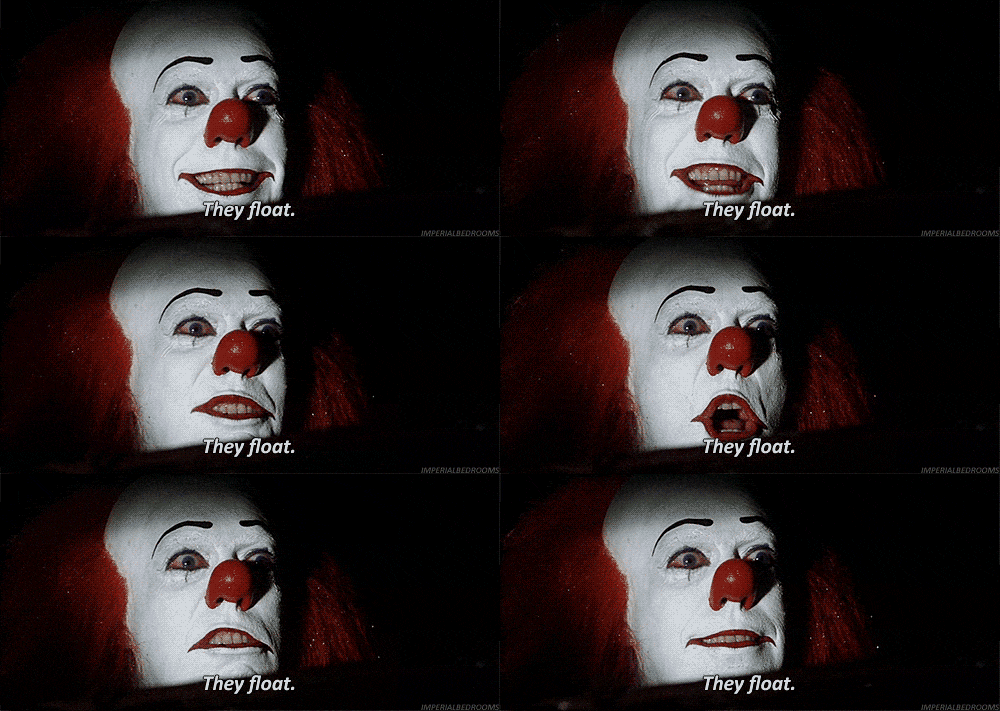
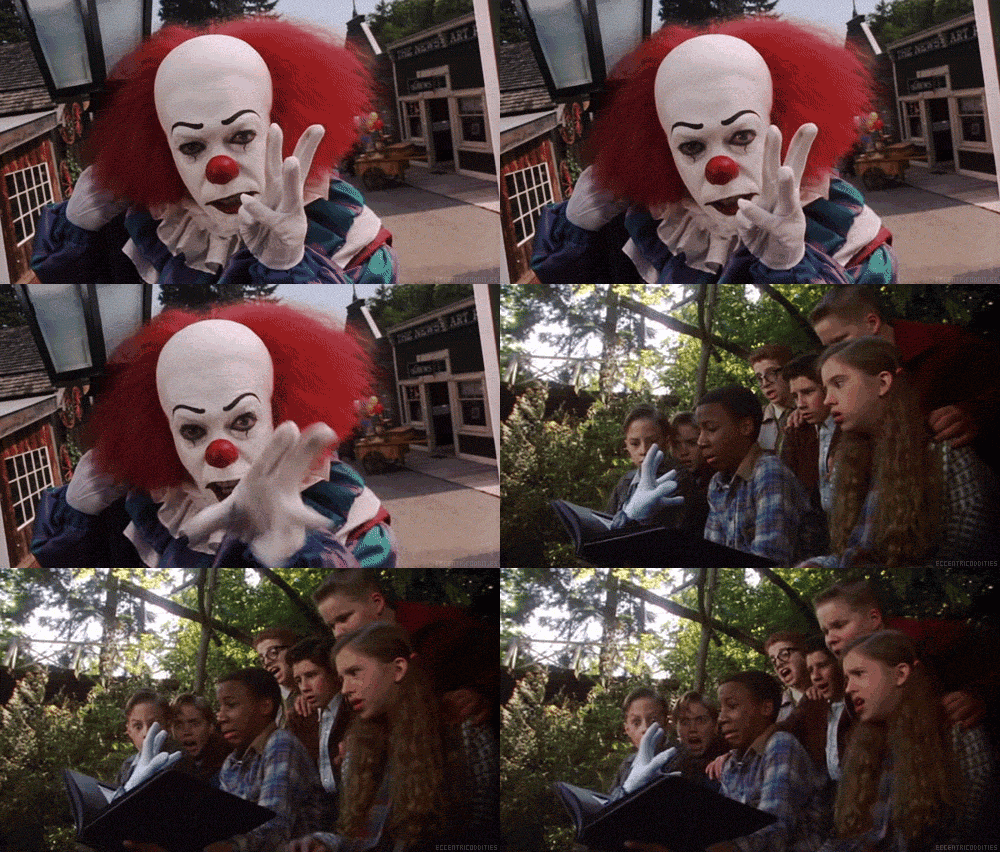
It's also argued that notorious clown figures in literature (Pennywise in Stephen King's It) and real life (John Wayne Gacy) have contributed to adults being averse to clowns. Additionally, the fact that much clown behavior is "transgressive" (anti-social behavior) can create feelings of unease.
The British arts and music festival Bestival cancelled its planned clown theme in 2006 after many adult ticketholders contacted the organizers expressing a fear of clowns.

